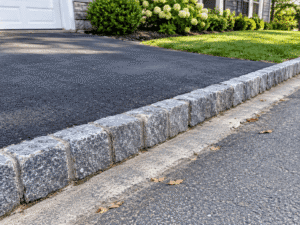
Drive through almost any North Jersey town and you’ll see the same detail over and over: a row of squared granite blocks edging the driveway, running along the street, or wrapped around a flower bed. People who move here from elsewhere notice it immediately. People who grew up here stopped seeing it years ago.
Belgium block is a quarried granite block, usually rectangular, set in a row to form an edge or a curb. You’ll also see it spelled Belgian block, and it’s the same thing. Around here it shows up in four places: bordering a driveway, forming the apron where the driveway meets the street, curbing along the road, and edging beds and walkways. Whether it stays straight for decades or starts leaning in a few seasons comes down almost entirely to what it was set in.
Why It’s Everywhere Here
Two practical reasons.
The first is the streetscape. Granite edging suits the older residential streets common across North Jersey, so a block border reads as normal here in a way it wouldn’t somewhere newer.
The second is what the edge has to survive. A driveway edge in this part of the country takes snow plows, road salt and a freeze-thaw winter, and a granite block set into concrete handles all three better than an asphalt lip or a strip of plastic edging. Once enough driveways on a street have it, the look becomes the default.
Where Belgium Block Is Used
The driveway border. A single row down each side of an asphalt or concrete driveway. It keeps the edge from crumbling, which is a common failure point on an asphalt driveway, and it gives a plain driveway a finished line.
The apron. The section where the driveway meets the street takes the most abuse: turning tires, delivery trucks, and the plow. Blocks here handle that better than an asphalt edge.
Curbing along the street. Set as a raised edge, the blocks define where the lawn stops and direct water down toward the drain rather than across the lawn.
Edging beds and walkways. The same block, usually set lower, holding mulch in and keeping a mower line clean.
Occasionally someone does an entire driveway in block. It’s a serious piece of work, and it’s rare for good reason.
Haskell, NJ
Planning a driveway border or a new curb?
Pete installs Belgium block curbing and edging, and he gives every estimate himself, free.
What Actually Goes Under the Blocks
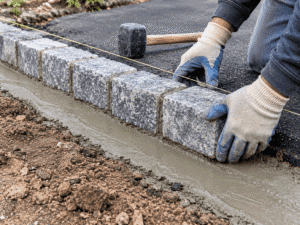
Belgium block is heavy, but weight alone doesn’t hold it in place. What holds it is the concrete underneath, and that’s the part you can’t see once the job is done. Here’s how Pete’s Concrete & Masonry sets it:
- The old curb, if there is one, is removed and the area is formed at an 18 inch depth.
- Concrete is poured into the forms, and the blocks are set into the concrete.
- There’s typically a 1 inch joint between each block.
- For Belgium block around flower beds and driveways, there’s usually a concrete base of roughly 10 inches deep.
A block bedded into poured concrete behaves as part of a single mass. A block laid on sand or packed soil is a loose object with a stone’s weight on top of soft material. It can be pushed by frost, washed under by runoff, or shoved sideways the first time a tire clips it. That’s the difference between a curb that stays in line and one that starts dipping into the lawn.
Joints matter too. The gap between blocks is filled so water doesn’t run straight down between them and wash the bedding out from underneath.
What Makes a Belgium Block Curb Fail
Nearly every failure traces back to the same few things:
- A thin or missing concrete base. The blocks move independently, and once one tips, the ones next to it follow.
- Frost. Water in the ground under and behind a curb freezes and expands, pushing up and out. A curb set in a proper base resists it; one set in soil doesn’t. The same cycle works on masonry all around a property, covered in a separate guide on how freeze-thaw cycles damage masonry.
- The plow. A blade catching a high block can knock it out of line or chip it. A curb at a consistent height, properly bedded, gives the blade less to grab.
- Road salt. Salt is hard on the concrete holding the blocks and on the joints between them.
- Water running the wrong way. A curb is partly a drainage decision. Set without thinking about where the water goes, it dams runoff against the driveway or the lawn instead of guiding it.
Belgium Block Against the Alternatives
A poured concrete curb is one continuous piece rather than many, so there are no joints to maintain and nothing to knock out of line. It’s a plainer look, and when it cracks, the repair shows. Pete’s builds both, so this isn’t a case of selling you one over the other. Pete’s own concrete curbs run about 18 inches deep, 6 inches wide at the top and 9 at the bottom, in a 4000 psi mix.
Paver edging matches a paver driveway or walkway and comes in more colors and shapes. It’s generally lighter-duty than granite block against a plow.
Plastic or metal edging is the lightest-duty option and fine around a garden bed. It isn’t built for tire or plow contact, so it doesn’t belong along a driveway edge.
The practical split: granite block where vehicles, plows or runoff are involved, lighter edging where it’s only holding mulch.
Curb blocks leaning or knocked out of line after the winter? Call Pete directly.
Keeping It Looking Right
Belgium block itself is granite and essentially maintenance-free. The work is in the joints and the line:
- Keep the joints filled. Pete’s sets the blocks with roughly a 1 inch joint, and an open gap is where weeds and grass take hold.
- After a hard winter, walk the line and look for blocks sitting high, low or tipped.
- A block or two knocked out of line can usually be reset without touching the rest of the run. Catching it early keeps it a small job.
- Go easy on de-icing salt near the curb.
A block that’s been clipped and left loose lets water into the gap, and the base underneath starts washing out from there.
What to Ask Before the Work Starts
The useful questions are about what you won’t be able to see once the work is done:
- How deep is the base, and is the block set into poured concrete or bedded in sand?
- How will the joints be filled?
- Where will water go once the curb is in?
- How does the new curb meet the existing driveway, sidewalk and street?
- If an old curb is coming out, who removes and disposes of it?
Answers to those tell you more than the material list does. You can see how Pete’s approaches Belgium block curbing and edging in Haskell and nearby towns. The same base-first logic applies to patios and walkways, covered in the comparison of paver and concrete patios.
Frequently Asked Questions
Is it Belgium block or Belgian block?
Both are in use and they mean the same thing: a quarried granite block used for curbing and edging. Suppliers and contractors around here use them interchangeably.
Does Belgium block have to be set in concrete?
For a driveway border, an apron or a curb along the street, in practice yes. Edging that only holds mulch in a bed is sometimes set without it, and that is the one place it’s a fair choice. Anything a tire, a plow or running water reaches is a different job.
Can a single cracked or knocked-out block be replaced?
Usually. An individual block can be taken out and reset or replaced without rebuilding the whole run, as long as the base underneath is still sound. If the base has washed out or the blocks are moving along a stretch, that section is better rebuilt.
Thinking About a New Curb or an Edge That’s Gone Crooked
Whether it’s a new driveway border or a run of curb that’s drifted out of line, the thing to look at first is what’s underneath and where the water goes. Pete’s Concrete & Masonry installs Belgium block curbing, driveway borders and bed edging around Haskell and the surrounding towns, and Pete gives every estimate himself.